My father likes to talk. One of his favourite subjects is, unsurprisingly, his youth. He’s told me all kinds of stories – from his childhood, his times in the army, but mostly, stories from the time he spent as a tourist guide on the Bulgarian Black Sea coast back in the mid-1970s.
Being a tourist guide was a serious matter at the time. One had to complete a 2 year course at the National Institute for Tourism, a prestigious state-sponsored institution. The entry exams were hard, but my father did extremely well in his essay on the subject of scientific communism and got in. He was in his early twenties (two years of compulsory military service were the cause of this delay to his student adventures) when he completed his first year and was assigned a summer placement in Balkanturist, the state-owned tourist agency. He was based in the small town of Michurin, named after the prominent Russian horticulturist (current Tzarevo).
It was early in the season and there weren’t that many tourists. My father was on his lunch break, strolling around the town centre, when he saw a couple walking in a manner that indicated they were looking for something. He thought he could help, so he went over. These were Western German tourists. My father was learning Czech and German at the Institute, so communication wasn’t an issue. The tourists were planning a barbecue that evening. They asked:
-Do you know where we can get some meat? Beef , if possible.
My father thought for a moment.
-I can certainly take you to the butcher’s – he said, – but I am not sure if they’ll have any meat.
-How come? – their surprise was obvious.
-Well, occasionally, there are some problems with the supply chain… – tried to explain my father, but then thought that the reality of the Bulgarian supply chain in the mid-1970’s was somewhat complex and stopped.
They headed to the butcher’s. There was a man in his fifties there, reading the paper. No meat was in sight.
-Bay Ivan1 – my father said – have you any meat?
This question was not at all unfounded. The fact that there was no meat on display did not mean that there was no meat at all. Some of the best cuts could have been saved in a fridge at the back, waiting for some special foreign visitors, even more special relatives, or the most special of all – the local secretary of the Bulgarian Communist Party. My father and his guests were apparently not that special (or maybe there really wasn’t any meat), so bay Ivan said:
-I haven’t got any, son.
-Do you think you’ll have some later today? – inquired my father.
-It’s hard to say, son, it’s hard to say.
-And, if you have it, when, more-less, will that be? What time? – insisted my father.
At that point bay Ivan was obviously losing his patience.
-As soon as it’s delivered, it will be here! – he shrugged.
My father advised the German tourists to try their luck later that afternoon. He showed them the tourist information office where he worked, wished them luck in their quest for beef (adding that they may need to settle for whatever meat happens to be available, if any) and said he’d be in the office, should they need any more help.
The afternoon proceed in an uneventful fashion. It was early in the evening when two familiar-looking people entered the tourist office. These were the German tourists, carrying plastic bags, big smiles on their faces.
-We’ve got beef! – they told my father. – Why don’t you join us for a barbecue this evening?
He thanked them for the invitation and went to this barbecue and the many others that followed (How was the meat for all these barbecues procured remains a mystery.). These were good people, he added. And times were different.
My father’s story brought back many memories. Grocery shopping in Eastern Europe (I am thinking mostly Bulgaria and Poland, the two countries I am most familar with) back then, and also up until the 1990s, was more of a real adventure than a straightforward affair. It required perseverance, patience, connections and at times – just pure luck.
I remember the two main grocery shops in the small town west of Sofia, where I grew up, close at lunch to reopen at, perhaps, 4 pm. The pensioners and children would start queuing some hours prior to opening, especially if there were news of a delivery truck coming in. At that time, somehow, there was always a shortage of a particular type of groceries. If there was a delivery, you’d have to scramble over others to get your hands on the precious item in question. But then again, it wasn’t all that bad. The community spirit was very much alive. A lot of people grew their own vegetables and many had animals, so eggs, milk, etc. could be bought from the neighbours. There were jokes and banter in the queues. An interesting fact about these times was that oranges, tangerines and bananas became available only around Christmas (which was celebrated unofficially) and New Year’s Eve. A song of the Bulgarian then-teenage singer, The Count (Bulgarian Grafa, an alias of Vladimir Ampov) testifies to this: Tangerines, tangerines, shine the festive shop windows. Tangerines around here come with Santa only.
Something I remember vividly back from these times in Bulgaria were the constant issues with the supply of water and electricity. Electricity would usually (but not only) go in the winter, water – in the summer. And you never knew when they’d make a comeback. Some people had wells. Others, the majority, kept water in huge plastic containers and also had gas laps, gas cookers and candles on hand. But how would you watch the next exciting episode of Isaura, the slave, an incredibly popular Brazilian soap opera, with no electricity? Here’s how: a neighbour from the tower block or the nearby houses would bring out a smaller size TV, would connect it to the electricity generator of someone’s Moskvich (a Soviet brand of cars) and then the neighbours would gather round the TV set – everyone was keen to keep up with Isaura’s latest adventures.
This is how the adults managed. But what about us, children, who were desperate to watch A million and one wishes, a TV programme for kids and teenagers that was probably aired quarterly and re-ran some of our all-time favourite films and cartoons? The electricity issue was so widespread that a number of children wrote letters to the producers, expressing anxiety that they won’t be able to watch the programme for this reason. To this day, I remember the host, a young lady known as kaka Lili (kaka – older sister; or any older than you, youngish female) announcing sweetly that the relevant authorities had agreed to ensure that there’d be no power cuts for the duration of the programme, 3 hours or so. Now is the time to put the washing on! – said, matter-of-factly, my mother.
One last comment about this – much later, in Manchester, I met I an Indian student during a morning run in the park.
-How do you like the UK? – I asked.
-Oh, it’s great! – he responded, enthusiastically. – I’ve been here for nine months and there hasn’t been a single power cut!
In the 21st century, it it so easy to take for granted the availability of food, water, electricity. In spite of the many challenges of these gone-by days, I wouldn’t change them for anything.
If you are thinking of visiting Bulgaria, do, by all means. You will find spectacular scenery, cordial people and – yes – great food. Don’t forget to try the mixed grill. It will be there, waiting for you – you wouldn’t have to go looking for the ingredients.
References:
1 Bay Ivan – bay is a way to address an older man you’re familar with in Bulgaria; it should be followed by the first name. This is quite close to Turkish, where bey means mister.
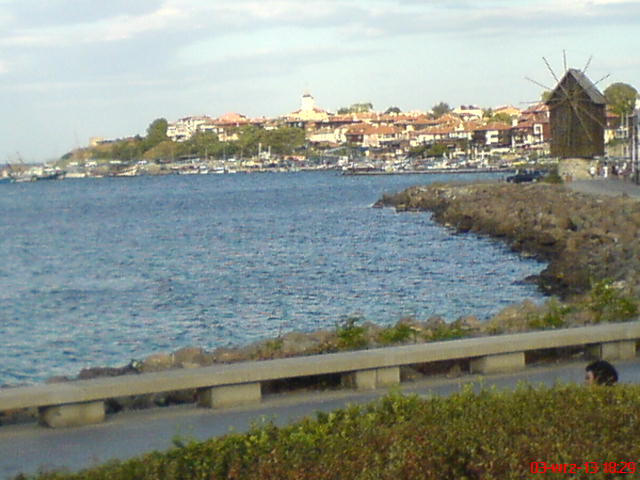
2 Photograph: approaching the town of Nessebar, Bulgarian Black Sea coast


